2026-09-17
No one objects to AI as a spell checker. 80% object when a book is (partly) written by AI.
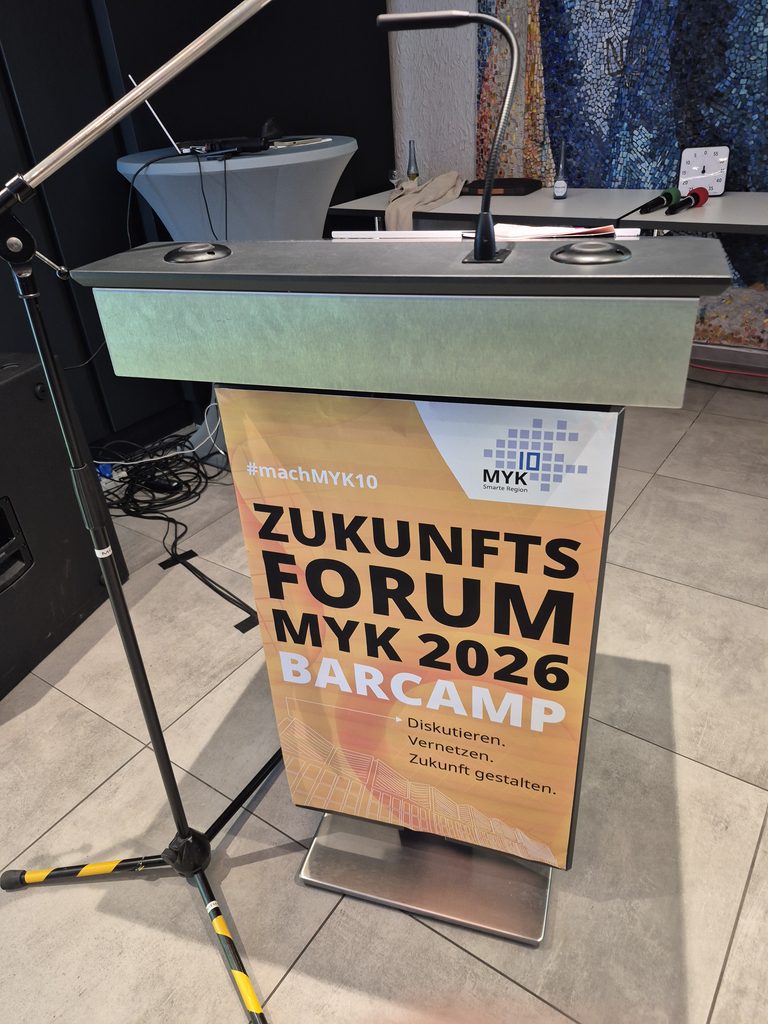
Last week, on the Zukunftsforum MYK10 (a “Future Forum” in Andernach/Rhineland-Palatinate), Joachim has led a spontaneous barcamp session about AI and creativity. Barcamps are great, especially if they are as wide in the topic as this one, reaching from economy to urban environment, from regional non-profit organizations to artificial intelligence: you meet people with very different interests and very different backgrounds.
A good place to get some unfiltered views about what AI means for human creativity. Here are some impressions:
- an artist is concerned about people losing skills and interest in the creation process of art, while the creation is a major part of art
- a cultural association sees a lot of advantages of AI for their administrative work, their marketing, creation of flyers, etc., while the (choral) music they are working for stays untouched by AI
- a graphics designer/company owner observes that the job market for designers is getting more and more difficult
- a sales consultant specializing on AI is convinced that it will not take long until people will get saturated with AI images, AI music, and other pieces of creative AI, and turn back to human-created works; still, for business, AI will be a major accelerator
We ended the session with an improvised poll, referring to discussion around Nobel Prize winner Olga Tokarczuk who openly claims using AI for some parts of her writing. What AI use would people in the room find acceptable when reading a book? Here are the rough percentages of the poll which asked:
“Would you read a book if you knew that in the writing process, the following AI techniques were used?”
- AI for spell/grammar checking: 100%
- AI for background research: near 100%
- AI as an editor who gives opinions, critics, but does not write the book: 50%
- AI which writes parts of the text: 20%
So there is a sharp drop: AI for “technical help” (grammar/spell check, research) is fully accepted by now. AI which intervenes with the creative process has far less acceptance.
It’s not a representative study. But the session showed that barcamps are a great way to spawn discourse, make connections, and get people to talk about responsible AI use, even if they are not deep in the bubble!