
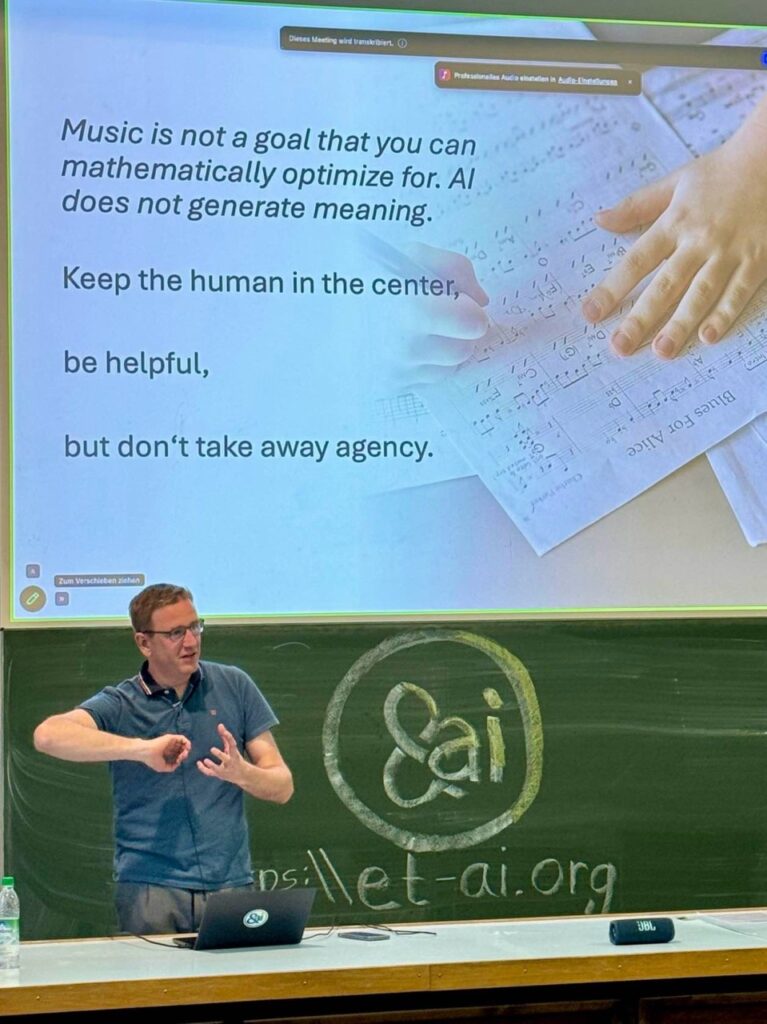
On May 28, 2026, we celebrated our first public presentation at the Technical University of Munich (TUM). As part of a Knowledge Sharing Session hosted by Munich Music Labs, Joachim spoke on the topic “The Disruption of Meaning – AI, Music, Ethics.” It was a highly interactive event, with intense engagement from both the in-person and online audiences.
We kicked off with a blind comparison of two versions of a short film scene. One version featured AI-generated music (Google’s Lyria 3 model, prompted to track shifts in mood second by second), while the other featured a purely human-composed score. The result of the blind test was stunning: even today, listeners could no longer clearly distinguish which music was of human origin and which was machine-made.
It was only upon closer analysis that the crucial difference became clear. The human composer added an extra layer of meaning to the scene through his music. He deliberately used an 8-bit video game aesthetic, acoustically transporting the audience into a completely different world than the visuals suggested. (You can watch the uncut clip featuring the award-winning music here on YouTube). The AI failed to generate such a subtle, secondary layer—even though a “genre change” had been explicitly requested in the prompt.
As the evening progressed, we examined how new technologies have transformed music production over recent decades. On one hand, they break down barriers to entry and democratize access to music creation—culminating today in “prompt-to-song” generators. On the other hand, they lead to standardization (such as song structures heavily altered by streaming) and fierce market crowding. When the market is flooded with mass-produced songs, standing out musically becomes increasingly difficult.
Naturally, questions of copyright and the ecological footprint of AI data centers were also raised. However, especially within the Munich Music Labs community, one central question took center stage: How can we design technology and software to expand human agency and creative integrity, rather than subtly suppressing them through software design?
The subsequent debates on AI authorship, machine consciousness, and the broader societal impacts resonated long after the event concluded. A thoroughly successful kickoff for the &ai presentation series!
Arcisstraße 21, 80333 Munich; Auditorium: Building 0502, Ground Floor, Room 220